Mini Golf Club-PvP Multiplayer
- 4.6
- Rating
- 1.00M
- Installs
- Free
- Price

 Analysis by App-foxy
Mini golf is usually at its best when the rules are easy to understand but the small decisions still matter. That is the feeling I got from Mini Golf Club, a free sports game from BoomBit Games that turns short putting challenges into competitive PvP sessions. I can pick it up for a quick round, focus on angle and strength, and then immediately feel the pressure of trying to finish ahead of another player.
What makes it appealing is not a complicated career system or a realistic golf simulation. It is the compact format. Each shot gives me a clear problem to solve, and each mistake is easy to understand. The game is aimed at Everyone, so it is approachable for younger players and casual adults, while the leaderboard gives more competitive players a reason to keep refining their technique.
After spending time with it, I see a game that works best in short bursts. It is suitable for a break, a friendly challenge, or a few rounds while waiting somewhere. It is less convincing as a deep substitute for a full golf game, and players who dislike competitive pressure or in-app purchases may find the surrounding progression less comfortable. Still, the central putting action is immediately readable, which is exactly what a mobile mini golf game needs.
You May Also Like

 Blood Strike: 2.5 Anniversary
Blood Strike’s Loadouts Turn Every Drop Into a Tactical Gamble
A close look at Blood Strike’s custom loadouts: how fast access to signature weapons reshapes its battle royale rhythm, rewards preparation, and narrows the gap between fights.

 Pandora - Music & Podcasts
Pandora’s Music Is Easy to Start, but Harder to Recover
Pandora’s strength is its low-effort path from a seed to a station. Its weak spot is how much confidence it asks you to place in connection, setup, and quiet recovery.

 8 Ball Pool
 Is Built on Rivalries, Rematches, and Routine
A close look at the rivalries, rematches, shared routines, and unanswered safety questions that turn a quick pool match into a persistent mobile community.

 Samsung Music
’s Quiet Strength Is Playing What You Already Own
Its reach comes less from spectacle than from dependable access to a personal library. That simplicity is both the app’s strongest retention engine and its ceiling.

 AccuWeather: Weather Radar
AccuWeather Review: A Quick, Clear Forecast for Everyday Decisions
For everyday plans, the best forecast is the one you can understand quickly. AccuWeather makes rain timing, radar, and local conditions easy to act on, with a few trade-offs.

 Hill Climb Racing
Why Hill Climb Racing Still Turns Crashes Into One More Run
A tiny car, a bumpy hill and one more upgrade: Hill Climb Racing keeps resurfacing because its simple chaos makes every near-miss feel personal.
More From Our News Desk
View All News


How the presentation sets the mood
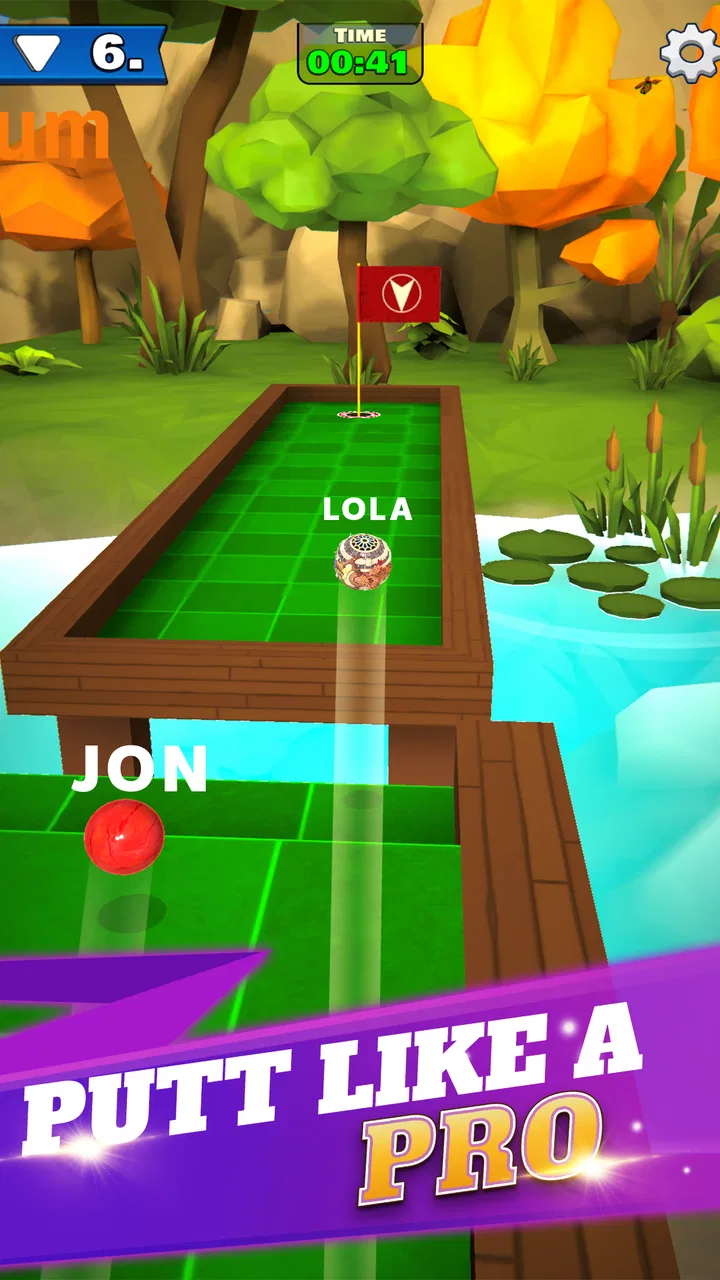
I find the presentation works best when I treat each course as a small, readable puzzle rather than a miniature golf simulation. Its playful look keeps the mood light, while the clear focus on obstacles and shot choices makes it easy to settle into a round without a long warm-up. That visual clarity matters most when a match gets competitive, which is where the game’s strengths and limitations become easier to judge.
A bright first impression built around quick play
The first thing I notice is how directly the game communicates its purpose. This is not trying to make me study a large map, learn a long list of controls, or manage a complicated sports team. It puts the mini golf idea in front of me and lets the course become the main event. That simplicity is valuable on a phone, where I may only have a few minutes and do not want a long tutorial before taking a shot.
The visual direction supports that accessible approach. The courses feel designed as playful challenges rather than serious country-club environments. Their identity comes from obstacles, slopes, routes, and the way each hole asks me to judge a different situation. I am not playing for a realistic golf atmosphere; I am playing for the satisfying moment when a carefully aimed ball follows the route I imagined.
That distinction also explains why the game can appeal to people who are not normally interested in sports games. The controls are connected to putting, but the experience is closer to a mixture of spatial puzzle and competition. I can think about geometry, timing, risk, and recovery without needing any knowledge of real golf. The sports category gives the game its theme, while the short obstacle courses supply its puzzle-like personality.
The free entry point makes it easy to test that personality without committing money first. The game has an average rating of 4.6 from around 63 thousand ratings, and it has passed one million installs. Those figures suggest that the straightforward format has found a broad audience, although popularity alone does not remove the need to decide whether the competitive structure suits me personally.
Reading the course instead of rushing the shot
My most useful adjustment was to stop treating every hole as a simple power test. The obvious route is not always the safest route. A direct shot may look attractive, but a rebound or a controlled approach can leave the ball in a better position for the next attempt. In a PvP match, that matters because a spectacular shot is not automatically better than a conservative one that avoids a costly mistake.
I also found it helpful to separate aiming from force. When I changed both at the same time, I could not tell why a shot failed. When I first chose the direction and then adjusted strength, the result became easier to read. That small habit turns the game from random tapping into a repeatable process. It is one of the reasons the simple control scheme has more room for improvement than it first appears.
Players who are new to this type of game should expect a short learning period. The basic action is obvious, but judging how much force is needed near walls or obstacles takes practice. The early rounds are useful for learning the visual language of the courses: where a ball can bounce, how much space is needed for a clean approach, and when a safer angle is worth an extra stroke.
Art direction that keeps the action readable
In a game built around aiming, visual clarity is more important than decorative detail. I need to see the playable surface, the hazards, the boundaries, and the target without fighting the interface. Mini Golf Club benefits from keeping the course itself at the center of attention. The playful look gives the holes character, but the presentation still serves the shot rather than burying it under visual noise.
That creates a coherent mood: light, competitive, and slightly mischievous. The setting does not ask me to take the sport seriously in the traditional sense. Instead, it makes each course feel like a compact playground where a good bounce can be as important as a straight putt. This tone is especially effective when playing with friends, because a lucky-looking rebound can become part of the fun rather than simply feeling like a simulation error.
There is a trade-off here. Anyone searching for the calm realism of a traditional golf title may find the presentation too playful. I would choose a more simulation-focused alternative if I wanted club selection, detailed course management, or a slower outdoor atmosphere. This game is better for someone who wants the visual language of mini golf itself: colorful obstacles, quick problems, and a clear route toward the hole.
Sound and rhythm during a match
The audio contributes to the game’s sense of pace by keeping the focus on the shot and its result. In a short PvP round, sound does not need to create an elaborate cinematic world. It needs to help the action feel responsive: the launch, the movement, the contact with the course, and the final result should all feel like parts of one small event.
I think the game’s rhythm works because the moments between shots are naturally limited. I am not waiting through long stretches of travel or watching an extended sports broadcast. I make a decision, see the result, and prepare for the next decision. That loop gives the game a pleasant stop-and-start flow, making it suitable for a quick session while still leaving room for tension when the scores are close.
The same rhythm can become less relaxing when I am focused on the leaderboard. A missed angle is not just a visual mistake; it changes the pressure of the next shot. When I play casually, the sound and movement make failure easy to shrug off. When I am trying to beat another player, every bounce seems louder because it affects the match. That contrast is useful: the game can feel playful or competitive depending on how seriously I approach the result.
For a group of friends, the short format is a genuine strength. It is easier to agree to a few holes than to begin a long sports campaign. A friend who does not usually play mobile games can understand the objective quickly, while a more experienced player can still enjoy the challenge of choosing better lines. The shared activity comes from comparing decisions, not from needing a large ruleset.
Where the mechanics fit the mood
The central mechanic is a strong match for the presentation because it is both physical and thoughtful. Pulling back or adjusting a shot gives the action a tactile quality, but the important part is still judgment. I have to estimate distance, anticipate a rebound, and decide whether to play safely. The game therefore avoids being only a reflex test or only a static puzzle.
The PvP focus adds a useful layer of urgency. In a solo puzzle, I can retry a difficult line without worrying about another player’s progress. Against an opponent, I have to balance ambition with consistency. A risky shortcut might save a stroke, but a poor rebound can put me behind. That trade-off is where the competitive design becomes more interesting than simply trying to hit the hole as directly as possible.
One practical tip is to treat the opening shot as information as well as an attempt to score. Early in a session, I pay attention to how the ball reacts to the course instead of immediately repeating a failed idea. That helps me build a mental picture of the surface and makes later shots more deliberate. It is a small workflow, but it reduces frustration and gives practice a purpose.
Another useful habit is to avoid chasing a perfect result after one bad stroke. I sometimes made a second mistake because I tried to recover too aggressively. A controlled next shot can be more valuable than an impressive rescue attempt. This is particularly important in multiplayer, where emotional reactions can make me play faster and less accurately than I would in a relaxed round.
The game’s free structure is convenient, though in-app purchases range from $0.99 to $99.99 per item. I would recommend playing long enough to understand the normal progression before buying anything. The lower-cost options may feel reasonable for someone who enjoys the game regularly, but the wide price range is a reminder to keep spending deliberate. Players who want a completely purchase-free experience should be prepared to ignore optional offers rather than treating them as part of the core putting challenge.
Who will enjoy it, and who should skip it
I would recommend this game to someone who likes quick competitive rounds, physics-based aiming, and sports games that are easy to learn but allow gradual improvement. It is also a good choice for casual multiplayer with friends because the premise is immediately understandable. A player can start by aiming at the hole and gradually learn more advanced habits such as using safer rebound angles and controlling recovery shots.
It suits families reasonably well because the age rating is Everyone and the objective is clean and uncomplicated. That does not mean every child will find the competitive format comfortable. Younger players may need help understanding why a powerful shot is not always the best shot, and adults may want to supervise purchases on a shared device. The game is accessible, but its leaderboard can still create pressure for players who are sensitive to losing.
I would skip it if my priority were a deep golf simulation, a long narrative, or a highly detailed management system. I would also look elsewhere if I wanted a purely peaceful solo experience with no competitive emphasis. The PvP identity is central to the appeal, so someone who dislikes comparing results may only experience part of what the game is designed to do.
It is worth remembering that this is a mobile game from BoomBit Games, currently listed at version 1.0.4 and requiring Android 7.0 or later. That makes it accessible to many older Android devices, but compatibility is not the same as identical performance on every phone. On a device with a small screen, careful aiming may feel less comfortable, while a larger display gives the course and shot direction more breathing room.
Everyday situations where it works best
My favorite use case is a short break when I want something more engaging than scrolling but do not have time for a full game. I can play a few holes, concentrate on a handful of decisions, and stop without feeling that I have abandoned a long campaign. The game’s rhythm is particularly well suited to that kind of fragmented schedule.
It can also work as a low-effort social activity. Two friends can compare their approaches to the same kind of obstacle, laugh at an unlucky bounce, and then try again with a better plan. The important point is that conversation does not have to stop completely; the rounds are compact enough for the game to sit alongside casual talk rather than demanding a long uninterrupted commitment.
For practice, I suggest focusing on consistency rather than immediately pursuing leaderboard results. Choose a repeatable aiming routine, watch how much force produces a controlled roll, and only then experiment with riskier shortcuts. This approach makes the learning curve feel fairer and helps distinguish a genuine improvement from a lucky bounce.
Final thoughts on its playable atmosphere
Mini Golf Club succeeds because its art direction, sound, setting, and pacing all point toward the same experience: a bright, compact contest built around one clear action. The courses provide enough personality to make shots memorable, while the mechanics keep the mood grounded in judgment rather than decoration. I never need to wonder what the game wants me to do, and that clarity is one of its strongest qualities.
Its limitations are equally clear. The experience is not designed for players seeking realistic golf, extensive solo depth, or a completely pressure-free pastime. The presence of in-app purchases means I would keep an eye on spending, and the competitive structure may be more appealing to some friends than others. Those are important considerations, but they do not undermine the basic pleasure of lining up a difficult shot and watching it take the route I planned.
With a 4.6 average and more than one million installs, it has already attracted a substantial mobile audience. I understand why: the game is approachable within minutes, yet small changes in angle and force can make a noticeable difference over time. My main recommendation is to play it as a short skill game, not as a full golf replacement. If that matches what I want from a sports title, this is an easy one to keep installed for quick challenges and friendly competition.
For me, the final verdict is positive but specific. I would recommend it to a friend who enjoys mini golf, physics-based challenges, and leaderboard tension, especially when that friend wants sessions that begin quickly and end cleanly. I would point a simulation fan toward a different option, but for playful PvP putting with a coherent visual mood and a satisfying shot-by-shot rhythm, Mini Golf Club is a convincing free choice.
FAQs for Mini Golf Club-PvP Multiplayer
01What platforms is Mini Golf Club-PvP Multiplayer available on?
Mini Golf Club-PvP Multiplayer is available for download on both Android and iOS platforms. You can find the app on the Google Play Store for Android devices and the Apple App Store for iOS devices. Make sure your device meets the minimum system requirements for optimal gameplay.
02Does Mini Golf Club-PvP Multiplayer require an internet connection?
Yes, Mini Golf Club-PvP Multiplayer requires an internet connection to access its multiplayer features. The game is designed to offer a competitive experience where you can play against other players in real-time. A stable internet connection ensures smooth gameplay and prevents interruptions.
03Is Mini Golf Club-PvP Multiplayer free to play?
Mini Golf Club-PvP Multiplayer is free to download and play. However, it offers in-app purchases that can enhance your gaming experience. These purchases may include additional levels, customization options, or power-ups. While optional, they can provide an advantage or add new dimensions to the game.
04What are the key features of Mini Golf Club-PvP Multiplayer?
Mini Golf Club-PvP Multiplayer boasts several exciting features, including real-time PvP matches, a variety of creatively designed courses, and customization options for your golfer. The game also includes leaderboards and tournaments, allowing players to compete globally and showcase their skills on a larger stage.
05How can I improve my skills in Mini Golf Club-PvP Multiplayer?
Improving your skills in Mini Golf Club-PvP Multiplayer involves practicing regularly across different courses to understand their unique challenges. Utilize the practice mode to refine your shots, experiment with angles and power, and watch replays of top players for strategies and tips. Engaging in tournaments can also help you gain experience and improve.
Pros
- Engaging multiplayer mode for competitive fun.
- Smooth controls enhance gameplay experience.
- Wide variety of creative courses to explore.
- Customizable avatars add personal flair.
- Regular updates with new features and levels.
Cons
- Occasional connectivity issues during matches.
- Some courses can feel repetitive over time.
- In-app purchases can be quite pricey.
- Advertisements can be intrusive at times.
- Limited offline play options available.

Mini Golf Club-PvP Multiplayer
Gallery